
CASE 003Category marketplace · Fresh commerce
Meat Stores: designing a specialist category inside a broad marketplace
A category-building story about specialised discovery, variable fulfilment, multi-brand choice, and the judgment required when a product’s next best home changes.
Read the decision story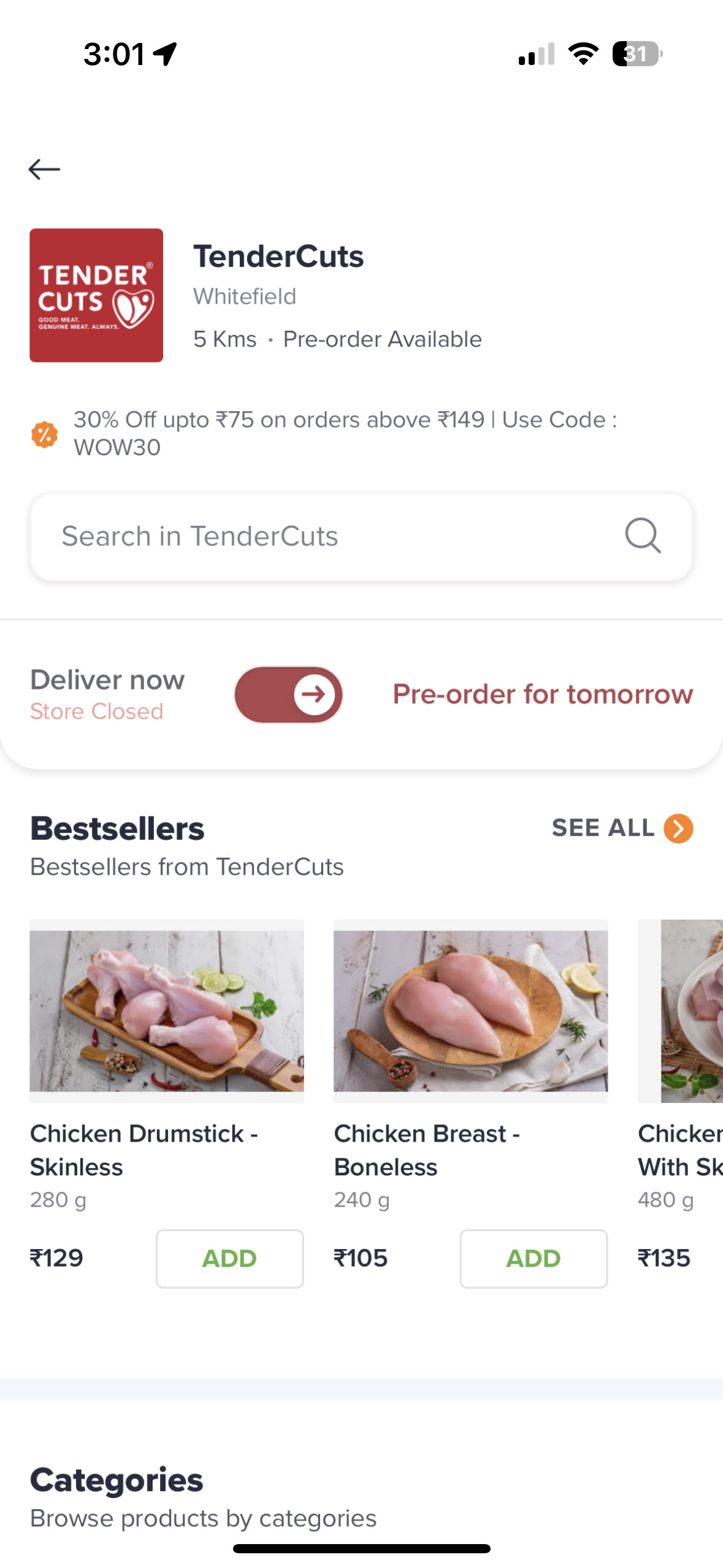
The situation
The catalogue was not interchangeable with a restaurant menu.
Customers needed to search across stores and products, compare quantities and cuts, understand whether an order was immediate or scheduled, and trust that the merchant could fulfil a perishable basket.
The experience had to feel familiar to an existing Swiggy user while adding enough category-specific structure to reduce uncertainty.
How do you make a specialised, high-consideration fresh category feel native inside a general-purpose delivery product?
Executive summary
Fresh meat looks like another retail category until the customer starts making decisions. Cut, weight, preparation, brand, availability, delivery window, and freshness expectations all shape the order.
Meat Stores created a dedicated category experience inside Swiggy, bringing specialist merchants and their catalogues into a more navigable discovery and ordering flow.
The product later evolved toward multi-brand aggregation and was ultimately discontinued, with customers directed toward Instamart. That arc makes this a useful story about both building and letting go.
The decisions
Four moves that shaped the product.
Create a dedicated category frame
A recognisable entry point, category language, and specialised merchandising gave the use case room to explain itself instead of forcing it into a restaurant-ordering mental model.
Support both store-led and item-led discovery
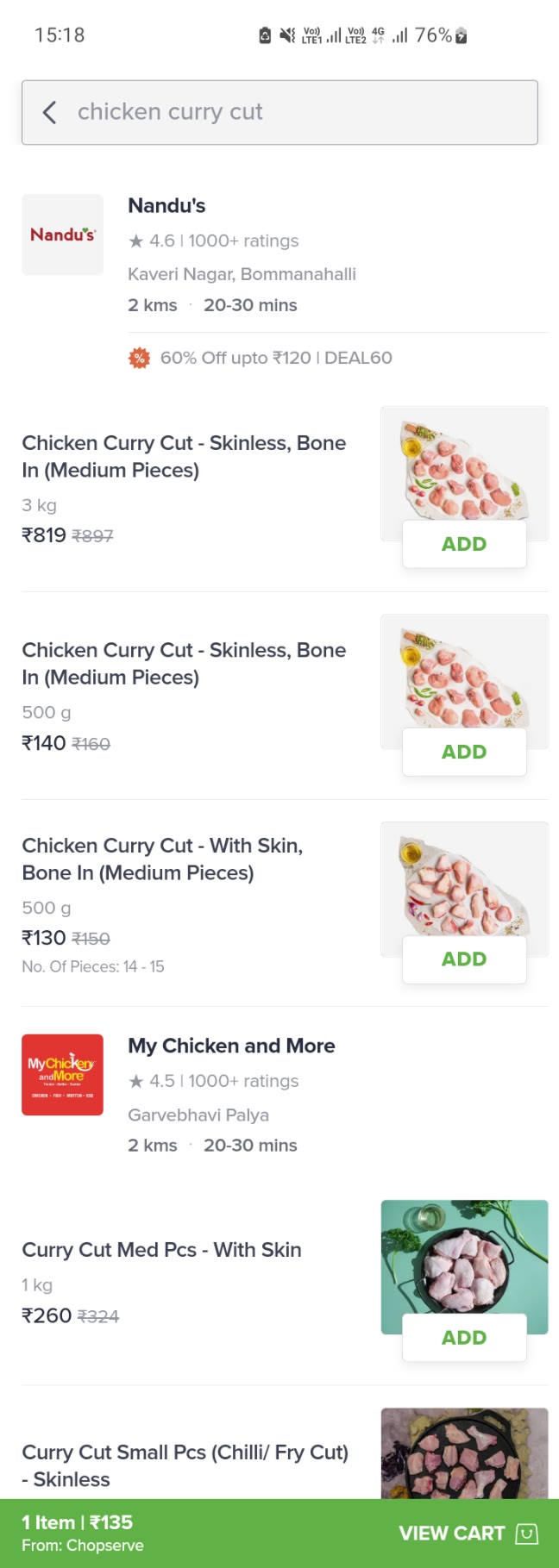
Some customers trusted a brand; others started with a specific cut or quantity. Search and catalogue structures allowed both journeys without pretending they were the same.
Make fulfilment constraints visible early
Store state, distance, delivery timing, pre-order availability, and product variants appeared before checkout. Constraints became part of the proposition rather than a late-stage surprise.
Preserve continuity when the product changed
When the standalone experience ended, the interface pointed customers toward relevant selection on Instamart. A product ending should still leave the customer with a clear next action.
Product artifacts
What to notice in the interface.
These are selected public-facing screens. Captions focus on the product choice—not confidential performance data.
Merchant identity, service area, offers, and delivery mode are visible before the customer enters the catalogue.
Item-led search lets customers compare pack sizes, prices, and stores without repeating the query.
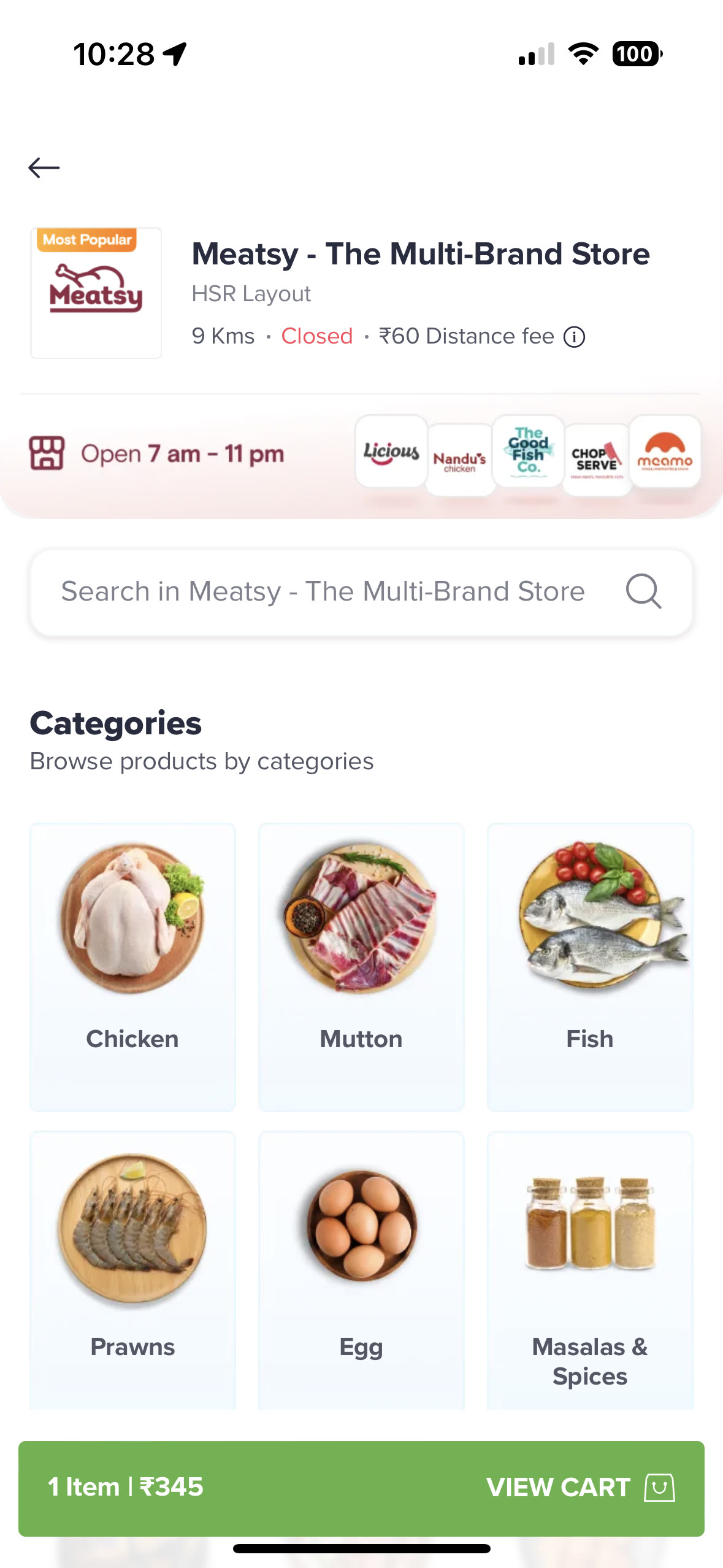
A multi-brand destination reduced navigation overhead while keeping category and brand cues visible.
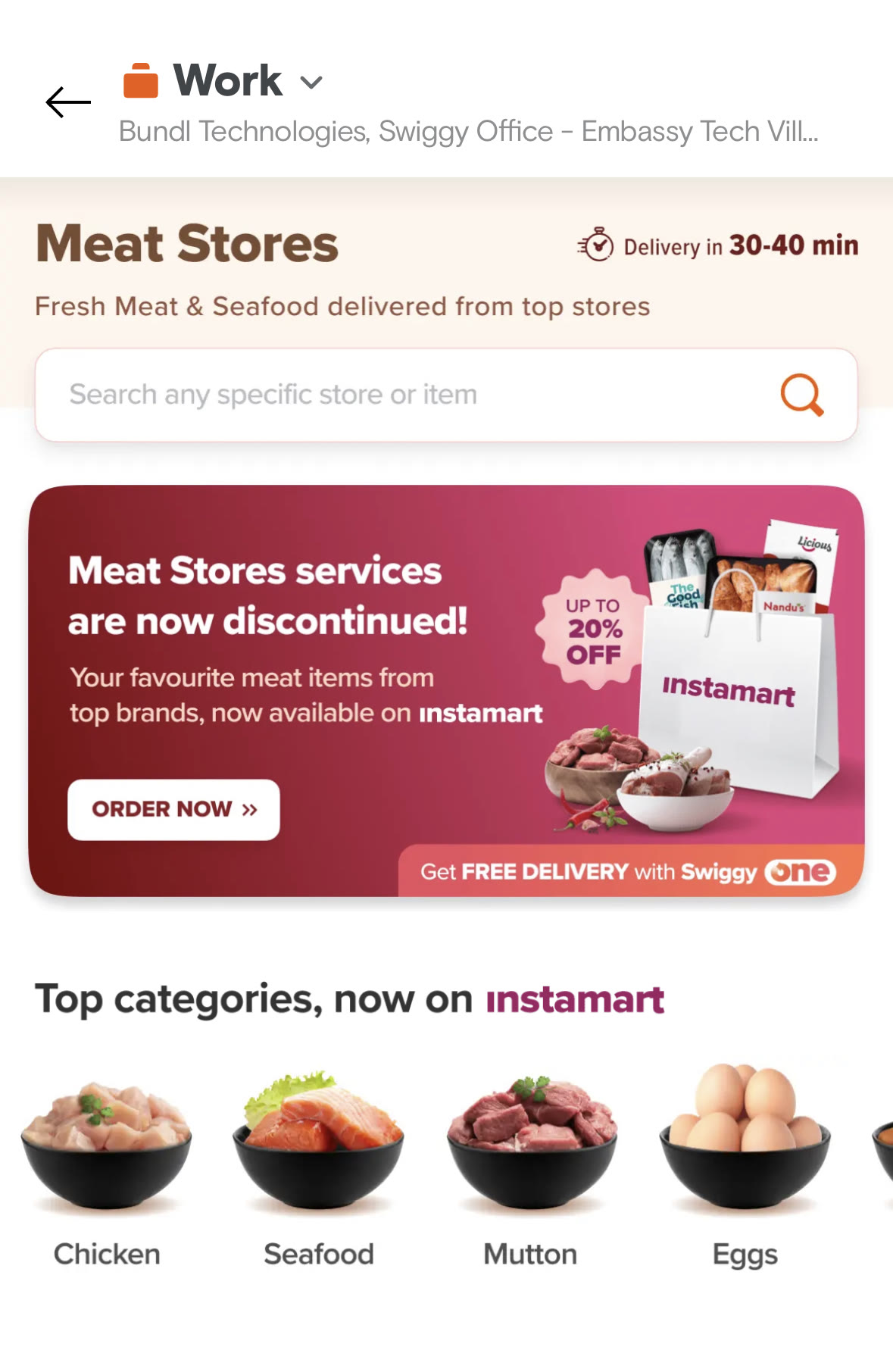
The closing state is an artifact too: it explains the change and gives the customer a next destination.
Outcome · public-safe
The ending is part of the product story.
The experience progressed from specialist store pages to broader aggregation. Public reporting later confirmed that Swiggy discontinued the standalone meat-delivery business while continuing relevant selection through Instamart.
Without publishing internal metrics or attributing a single cause, the durable lesson is clear: category products must earn their operational complexity, and a responsible transition is itself a customer experience.
Specialist choice becomes easier to navigate
Fulfilment constraints are explicit before checkout
A discontinued journey still offers continuity
Reflection
What travelled with me.
Category depth creates operational depth
Every useful customer distinction—cut, weight, freshness, slot, brand—creates catalogue and fulfilment work behind the interface. Product scope must include that operating reality.
Aggregation is a trade-off, not a universal answer
A multi-brand layer can simplify discovery, but it can also weaken merchant differentiation. The right level of aggregation depends on what the customer is actually trying to compare.
Opportunity cost belongs in product judgment
A product can solve a real problem and still not be the best use of organisational attention. Mature product leadership separates customer value from the decision to keep investing.
Evidence boundary
Useful detail without internal detail.
This case study uses public product screens, published company context, and qualitative product reasoning. It intentionally omits internal metrics, commercial data, roadmaps, and confidential operating details.